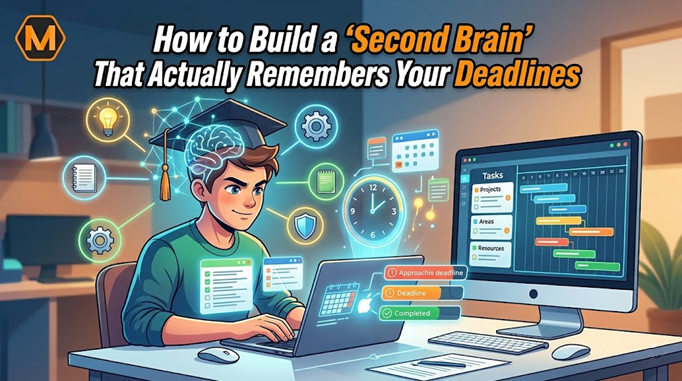
The feeling of a looming deadline is a universal student experience. You know the one—that sudden, cold realization at 11:00 PM that a major project is due the next morning. Most of us rely on our biological brains to store every lecture note, reading list, and submission date, but the truth is that our minds are built for having ideas, not holding them. This is where the concept of a “Second Brain” comes in. It is a digital system designed to capture, organize, and retrieve information so you can stop stressing about when things are due and start focusing on the actual work.
In the modern academic landscape, students are juggling more than just textbooks. You have social media notifications, part-time jobs, and complex research requirements all competing for your attention. Building a digital archive allows you to clear your mental clutter. For instance, if you are struggling to balance a heavy course load, navigating an economics essay writing service through myassignmenthelp provides a strategic way to manage high-stakes data while your digital system tracks the progress. By offloading the “storage” part of your education to a reliable external tool, you free up your cognitive energy for deep thinking and creative problem-solving.
The Science of Cognitive Load: Why You Forget
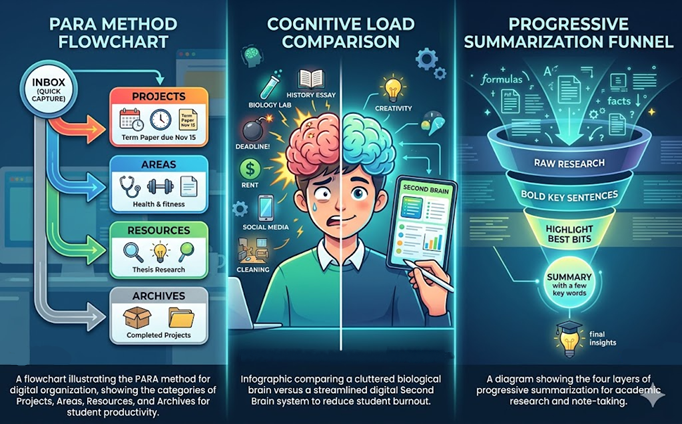
To understand why we need a digital backup, we have to look at how the human brain processes information. Our “Working Memory” is incredibly small. Imagine it as a tiny workbench. You can only fit a few tools on it at once. If you try to pile on a history essay, a math quiz, a lab report, and your grocery list, things start falling off the edges. This is known as Cognitive Overload.
When you create a Second Brain, you are essentially extending your workbench. Instead of keeping everything in your head, you move it to a digital space. This reduces “Zeigarnik Effect” anxiety—the mental pinging that happens when you have unfinished tasks swirling in your mind.
Phase 1: The “Capture” Architecture
The first step to building your system is creating a seamless “Capture” habit. The rule is simple: if it takes more than 30 seconds to remember, it belongs in the Second Brain.
What Should You Capture?
- The “Random Spark”: Ideas for a thesis or a creative project that hit you while walking.
- The “Syllabus Snippet”: Specific grading rubrics or “hidden” deadlines mentioned in class.
- The “Digital Asset”: A PDF, a YouTube video, or a podcast episode relevant to your major.
| Tool Category | Recommended Apps | Best Use Case |
| Quick Capture | Google Keep, Apple Notes | Short text, photos of whiteboards, voice memos. |
| Web Clipping | Pocket, Raindrop.io | Saving full articles or research papers for later. |
| Deep Storage | Notion, Obsidian, Evernote | Building the actual PARA folders and linking notes. |
Phase 2: The PARA Method (Organizing for Action)
Most students organize by subject: “Biology,” “History,” “English.” While this looks neat, it’s actually a trap. When a deadline is approaching, you don’t need to see everything you’ve ever learned about Biology; you only need the specific notes for the exam on Tuesday.
The PARA Method, developed by Tiago Forte, organizes information based on actionability:
- Projects: High-priority items with a hard deadline. Example: “Term Paper due May 10th.”
- Areas: Ongoing responsibilities with no end date. Example: “Financial Aid,” “Health & Fitness,” or “Dorm Life.”
- Resources: Interests or topics for the future. Example: “Photography,” “Graphic Design Ideas,” or “Cooking.”
- Archives: Completed projects. This is your “Digital Library” that you can search years later.
By putting your deadlines in the “Projects” folder, they stay at the top of your digital view. When the pressure mounts and you realize a submission is only hours away, finding a fast essay writing service can be the final piece of your project management puzzle, ensuring that even the tightest turnarounds are met with professional quality.
Phase 3: The “Weekly Review” (The Secret Sauce)
A Second Brain is like a garden; if you don’t weed it, it becomes a mess. The Weekly Review is a 20-minute ritual you perform every Sunday evening. This is what separates successful students from those who burn out.
The Weekly Review Checklist:
- Empty the Inbox: Move all your “Quick Notes” and “Photos” into the correct PARA folders.
- Review the Calendar: Look at the next 14 days. Are there any “hidden” deadlines?
- Update Project Status: If you finished a paper, move it to the “Archives.”
- The “Next Action” Check: Ensure every active project has at least one tiny, manageable next step written down.
Phase 4: Distill and Express (The 2026 Academic Edge)
In 2026, simply “knowing” facts isn’t enough; you have to be able to synthesize them. This is where “Progressive Summarization” comes in. Instead of reading a 40-page chapter and highlighting everything, you do it in layers:
- Layer 1: Capture the raw text.
- Layer 2: Bold the most important sentences.
- Layer 3: Highlight the “Best of the Best” in a different color.
- Layer 4: Write a 3-sentence summary in your own words at the top.
This ensures that when you go back to study for a final exam, you don’t have to re-read the whole book. You only read your 3-sentence summary and the highlighted bits. You are essentially “pre-digesting” the information for your future self.
Phase 5: Semantic Clustering and the “Link” Culture
Modern students are moving away from traditional folders and toward “Networked Thought.” Using apps like Obsidian or Roam Research, you can create “Backlinks.”
Imagine you are studying Sociology. You have a note on “Urbanization” and another on “Mental Health.” By linking them, you might discover a unique thesis angle about how city design affects student stress levels. This is “Information Gain”—creating new value from existing data. Your Second Brain becomes an idea-generating machine rather than just a dusty filing cabinet.
Overcoming the “Deadline Paralysis”
We’ve all been there: staring at a blank screen, paralyzed by how much work we have to do. This usually happens because the task is too vague. “Write History Paper” is a scary task. “Find 3 quotes for History Paper” is a 10-minute task.
Your Second Brain allows you to break big projects into “Atoms.” Because your research is already organized in your “Resources” folder and your deadline is tracked in your “Projects” folder, the friction of starting is gone. You aren’t starting from scratch; you are simply assembling the pieces you’ve already captured.
The Long-Term Value: Your Digital Legacy
Why put in all this effort? Because your education shouldn’t end when the semester does. Most students delete their mental hard drives the moment they walk out of a final exam. With a Second Brain, you are building a professional asset.
Five years from now, when you are in a job interview or working on a high-level corporate project, you can search your digital archives and find that one specific case study or framework you learned in junior year. You aren’t just passing classes; you are building a cognitive library that grows in value over time.
Summary Table: Biological vs. Second Brain
| Feature | Biological Brain | Second Brain (Digital) |
| Storage Capacity | Limited & Fades | Virtually Unlimited |
| Recall Accuracy | Subjective/Emotional | Perfect & Precise |
| Ideal Use | Creativity & Strategy | Storage & Organization |
| Searchability | Slow (vague “tip of tongue”) | Instant (Keyword Search) |
| Connectivity | Random Neurons | Structured Semantic Links |
Final Thoughts for the 2026 Student
The transition to university life is one of the most stressful periods a person can go through. The sheer volume of information can feel like a tidal wave. But you don’t have to swim against the current. By building a Second Brain, you are building a boat.
Start small. Pick one app today. Create your four PARA folders. Capture one deadline. As the system grows, your stress will shrink. Remember: your brain is a processor, not a hard drive. Let the technology handle the “remembering” so you can focus on the “thinking” and “achieving.” Success in the modern world isn’t about working harder; it’s about building better systems.
About the Author
Emma Jones is a senior academic consultant and lead content strategist for MyAssignmentHelp. With over a decade of experience in higher education, she focuses on helping students navigate complex research and academic challenges through clear, actionable strategy.
