The traditional boundaries between sciences are collapsing. Twenty years ago, a biologist worked with petri dishes and pipettes, while a computer scientist worked with silicon and syntax. Today, the most groundbreaking frontier in modern science exists precisely at the intersection of both.
Welcome to the era of bioinformatics—a discipline that uses advanced computation, data science, and statistics to decode the massive digital blueprints of living organisms.
In Australia, this field is undergoing an unprecedented boom. Driven by a massive influx of federal biotechnology funding, a world-class healthcare infrastructure, and the post-pandemic urgency to secure biological data sovereign systems, bioinformatics has quietly emerged as the nation’s most lucrative and intellectually thrilling new tech career. From analyzing the genomic variations of the Great Barrier Reef to sequencing cancer tumors for personalized medicine in Melbourne’s biomedical precincts, bioinformaticians are the data architects of the living world.
The Intersection of Biology and Big Data: What is Bioinformatics?
At its core, bioinformatics is the science of managing, analyzing, and interpreting biological data. The human genome project took over a decade and cost billions of dollars to sequence the first human blueprint. Today, high-throughput next-generation sequencing (NGS) platforms can sequence a genome in a matter of hours for under $1,000.
This technological leap has created a massive data deluge. A single human genome sequence generates roughly 200 gigabytes of raw data. When multiplying this by millions of patients, agricultural crops, and wildlife ecosystems, the data becomes unmanageable for traditional biology.
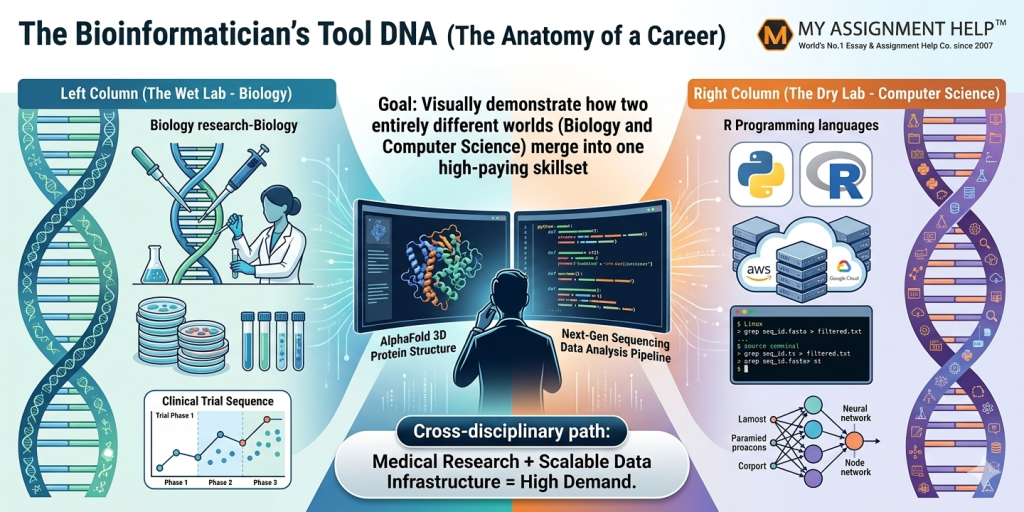
Bioinformaticians step in by writing custom Python and R scripts, building cloud-based machine learning models on AWS or Google Cloud, and deploying algorithmic pipelines to extract meaningful biological insights from terabytes of genetic noise. They translate millions of chemical base pairs (A, T, C, G) into actionable clinical insights, resilient crop variations, and evolutionary maps.
For students and tech enthusiasts attempting to master these highly complex cross-disciplinary skills, navigating the statistical modeling and computational pipelines can be incredibly demanding. If you are struggling to balance structural biology datasets with algorithmic scripting, seeking specialized bioinformatics assignment help can provide the structured guidance needed to bridge the gap between complex data science and advanced molecular biology.
The Australian Landscape: Why Now?
Australia is uniquely positioned to lead the global bioinformatics revolution. The Australian government’s National Reconstruction Fund (NRF) has earmarked billions for medical science and biotechnology innovation. Simultaneously, institutions like the Commonwealth Scientific and Industrial Research Organisation (CSIRO) and Australian BioCommons are investing heavily in building digital research infrastructure to support life science researchers nationwide.
Key hubs such as the Melbourne Biomedical Precinct, Sydney’s Tech Central, and Queensland’s translational research institutes are aggressively headhunting talent. The demand is heavily outpacing the local supply of graduates. Because the role requires an intricate understanding of both advanced software engineering and molecular biology, true bioinformaticians are incredibly rare—and Australian employers are willing to pay a premium for them.
Visualizing the Opportunity: The “Skill-to-Salary” Bridge
To understand why this field is commanding such competitive compensation across the country, it helps to examine how individual technical skills translate directly into career trajectory and salary ranges within the Australian tech and biotech sectors.
| Skill Matrix & Technical Domain | Primary Tools & Infrastructure | Typical Career Role | Average Salary Range (AUD) |
| Foundational Data Scripting | Python, R, SQL, Bash/Linux | Junior Bioinformatician / Data Analyst | $85,000 – $105,000 |
| Genomic Pipeline Engineering | Next-Generation Sequencing (NGS), Nextflow, Snakemake | Pipeline Engineer / Bioinformatician | $110,000 – $140,000 |
| Cloud Architecture & Big Data | AWS, GCP, Docker, Kubernetes, Bioconductor | Senior Bioinformatics Engineer | $145,000 – $175,000 |
| AI & Predictive Structural Modeling | AlphaFold, PyTorch, Deep Learning, Variant Callers | Principal AI Biologist / Director of Informatics | $180,000 – $230,000+ |
Mind-Blowing Fields Within Australian Bioinformatics
If you think this career is just about staring at excel spreadsheets of DNA sequences, think again. The daily applications of bioinformatics in Australia are genuinely mind-blowing:
1. Oncology and Precision Medicine
Instead of treating cancer with broad, destructive chemotherapy, hospitals like the Peter MacCallum Cancer Centre in Melbourne use bioinformatics to sequence a patient’s specific tumor DNA. Bioinformaticians run algorithms to find the precise mutations causing the cancer and match the patient with a custom-tailored targeted drug therapy.
2. Agricultural Resilience and Food Security
With climate change causing unpredictable weather shifts across rural Australia, agricultural tech (AgTech) is turning to genomics. Bioinformaticians at institutions like the University of Adelaide are analyzing the genomes of wheat, barley, and cattle to engineer drought-resistant, heat-tolerant strains, ensuring Australia’s food supply chain remains secure.
3. Fighting Extinction and Conservation Genomics
Australia’s unique wildlife faces severe ecological pressures. Bioinformatics is being deployed to save endangered species. By sequencing the genomes of the remaining Tasmanian Devil population, scientists can map out breeding strategies to combat the transmissible Devil Facial Tumor Disease (DFTD). Similar projects are mapping koala populations to understand chlamydia resistance.
The Career Roadmap: How to Become a Bioinformatician in Australia
Entering this lucrative field requires a strategic educational approach. Because it sits between two massive faculties, prospective professionals typically follow one of two academic pathways:
[Path A: The Biotech Route]
BSc in Molecular Biology / Genetics ➔ Master of Bioinformatics (Focus: Python, R, Cloud Computing)
[Path B: The Computer Science Route]
BSc in Computer Science / Data Science ➔ Master of Bioinformatics (Focus: Genomics, Proteomics, Biochemistry)
Universities such as the University of Melbourne, the University of Sydney, and the University of Queensland offer highly rated, specialized postgraduate programs in bioinformatics. Key core competencies you must build include:
- Programming Languages: Mastery of Python and R is mandatory.
- Statistical Analysis: Deep knowledge of hidden Markov models, Bayesian statistics, and machine learning architectures.
- Bioinformatics Tools: Familiarity with BLAST, GATK, SAMtools, and structural visualization packages like PyMOL.
The academic workload to balance these dual disciplines is notoriously intensive. Students often find themselves coding a complex sequence-alignment algorithm at midnight while simultaneously memorizing metabolic pathways for an exam the next morning. When the multi-disciplinary pressure mounts, it is common to ask, “can someone do my assignment for me” to stay on top of strict university deadlines without letting your Grade Point Average (GPA) slip. Managing your academic health strategically is vital when pursuing a high-stakes double-domain qualification.
Key Takeaways
- High-Growth Sector: Bioinformatics is one of Australia’s fastest-growing technology niches, blending biological discovery with advanced cloud computing and artificial intelligence.
- Lucrative Compensation: Due to an acute skills shortage, starting salaries sit comfortably around $85,000 AUD, with senior and director-level roles scaling well beyond $200,000 AUD.
- Diverse Impact Tracks: Professionals can build careers across highly impactful sectors, including human precision oncology, AgTech crop security, and native wildlife conservation genomics.
- Dual Skill Requirement: Success in the field requires continuous, balanced upskilling across both computational data structures (Python, Nextflow, Cloud pipelines) and molecular biology fundamentals.
Frequently Asked Questions (FAQs)
1. Do I need a PhD to work as a bioinformatician in Australia?
No, while a PhD was historically required for pure academic research roles, the commercial sector has shifted dramatically. Pharmaceutical firms, clinical diagnostic labs, and AgTech start-ups across Australia routinely hire professionals holding a Master’s degree or a specialized graduate diploma in bioinformatics, provided they possess strong data engineering and programming skills.
2. Which programming languages are most important for bioinformatics?
Python and R are the absolute pillars of modern bioinformatics. Python is primarily utilized for building scalable machine learning models, developing data pipelines, and handling text parsing of massive genomic files. R is heavily favored for statistical data analysis, differential gene expression modeling, and generating publication-grade data visualizations using packages like ggplot2. Additionally, a strong grasp of the Linux command line (Bash) and workflow managers like Nextflow is highly valued.
3. What industries hire bioinformaticians in Australia outside of universities?
Commercial job opportunities are expanding rapidly. Major employers include private pathology providers (such as Sonic Healthcare and Healius), global pharmaceutical firms, biotechnology companies (like CSL), government agencies like the CSIRO, and agritech firms focused on sustainable crop production. Medical research institutes like the Walter and Eliza Hall Institute (WEHI) and the Garvan Institute of Medical Research also employ large teams of commercial data engineers.
4. How has artificial intelligence impacted bioinformatics careers?
Artificial intelligence has acted as a massive catalyst rather than a threat. Tools like AlphaFold (which solves protein structure predictions using deep learning) have supercharged the field. Instead of automating the bioinformatician out of a job, AI has created an urgent demand for specialized data professionals who understand how to train, deploy, validate, and interpret these complex biological machine learning models.
Author Biography
Dr. Alistair Vance Alistair Vance is an Academic Research Consultant and Lead STEM Advisor at MyAssignmentHelp. He holds a PhD in Computational Biology from the University of Melbourne and has spent over seven years developing open-source algorithmic workflows for clinical genomic variant filtering. At MyAssignmentHelp, Dr. Vance leverages his professional experience in high-performance computing frameworks and statistical genetics to mentor students navigating complex bioinformatics curricula, cloud data architectures, and molecular dynamics modeling assignments.
Data Sources and References
- Australian BioCommons: National Infrastructure and Strategy Reports for digital life sciences (2024-2026).
- CSIRO (Commonwealth Scientific and Industrial Research Organisation): Future Digital Workforce Initiatives and Biomedical Sector Growth Trends.
- Australian Government Department of Industry, Science and Resources: National Reconstruction Fund allocation and biotechnology strategic investment directives.
- Peter MacCallum Cancer Centre Research Frameworks: Clinical implementation protocols for precision oncology and tumor genomic sequencing.
